Product Friction & Risk Report
February 17, 2026 • Komoot
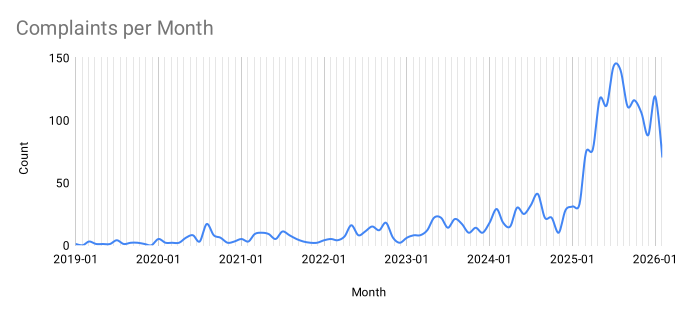
The acquisition of Komoot by Bending Spoons has transitioned the platform from a community-led utility into a high-scrutiny corporate product. While technical capabilities remain strong, our user intelligence with a focus on mid-2025 onwards reveals a significant divide between the product’s innovation and its operational stability. This analysis examines the current sentiment, identified gaps, and the competitive shifts impacting Komoot’s market share.
Competitive Landscape
The outdoor navigation market is currently bifurcated. On one side are the social-first platforms like Strava, and on the other are the utility-heavy tools like RideWithGPS and AllTrails. Strava continues to dominate the social space, but its decision to lock APIs and increase pricing has created an opening for Komoot. However, many users still treat Komoot as a specialized planning tool, exporting their data back to Strava for analysis. This indicates that Komoot has not yet successfully transitioned into a primary social fitness hub.
AllTrails remains the primary threat in the hiking sector, largely due to its superior user-generated review system. While Komoot’s routing is technically better, AllTrails provides more descriptive "on-the-ground" information that users crave. In the United Kingdom, OS Maps provides topographic detail that Komoot cannot match, though users complain that OS Maps lacks Komoot’s intuitive "snap-to-trail" planning.
Default ecosystem tools like Apple Maps and Google Maps are improving their cycling directions, particularly in Europe. For casual commuters, these free alternatives are becoming "good enough," which puts pressure on Komoot to justify its subscription model through highly specialized data, such as surface types and detailed elevation profiles. Emerging competitors like MapOut (Switzerland) are also gaining traction among users who prefer one-time purchases over recurring subscriptions.
Supporting Data
- 12/10/2025: "Garmin is in a safer position here as it will be much easier to make new apps similar to Strava."
- 28/01/2026: "Ditch the AllTrails and get rid of the subscription model... MapOut is Swiss made. One-time purchase."
- 02/02/2026: "I love Komoot for navigation but Strava is great for overall workout analysis."
- 16/01/2026: "I have the tick on Strava means that its connected. But why is it not syncing?"
- 29/04/2025: "Am I experiencing teething problems or is OS maps really not that great for small village planning?"
- 01/02/2026: "Google Maps, or Apple Maps for cycling? ... both can be disappointing for bicycle directions."
- 14/02/2025: "Google maps says there is no way to cycle from Saxon Switzerland to Prague. That seems a bit extreme."
- 13/07/2025: "I'm looking for an alternative to Komoot... RWGPS seems popular but I'm not convinced."
- 11/01/2026: "Komoot for comparison seems to get distance / height meter much better [than Garmin]."
- 20/03/2025: "Bending Spoons... model is to acquire companies and then squeeze money out of them by reducing operation costs."
Product Strengths
Komoot’s most resilient strength is its routing logic, which remains superior to most of the market. Its ability to distinguish between road types (e.g., state roads vs. cycleways) and surface types (e.g., gravel vs. asphalt) is a critical differentiator for gravel and road cyclists. This technical edge prevents users from switching to Strava or Google for their primary planning needs.
The launch of the standalone Apple Watch app in early 2026 has been a significant strategic win. By enabling offline, phone-free navigation with turn-by-turn directions, Komoot has effectively addressed the single largest request from the wearable community. Early sentiment suggests the app is robust, providing haptic feedback that allows users to keep their eyes on the trail. This has positioned Komoot as the preferred choice for the Apple Watch Ultra demographic.
The "Collections" feature also provides a level of organizational depth that competitors lack. The ability to group planned routes with photos and human-curated descriptions turns the app into a digital adventure journal. This human element, combined with the technical "Highlights" system, creates high switching costs for users who have spent years building their regional expertise on the platform.
Supporting Data
- 05/02/2026: "The new Komoot AW app... worked extremely well and has everything I actually need in a much simpler UI."
- 11/02/2026: "Collections!!!! OMG - this is AMAZING: ... MASSIVE improvement."
- 27/01/2026: "Apple Watch gains independence: Strava and Komoot bring offline maps."
- 26/01/2026: "Komoot's new standalone Apple Watch app: offline maps/routing, turn-by-turn, no phone required."
- 07/07/2025: "For my purposes, Komoot was the answer! It shows the amount of paved and unpaved roads."
- 17/01/2026: "Bukhansan National Park... loop route... I found it in Komoot. Excellent accessibility."
- 19/05/2025: "Komoot... Finden von Strecken in meiner Umgebung und «Bike Sehenswürdigkeiten»."
- 24/01/2026: "We released 80+ of the top requests, and used this research to define the latest product roadmap."
- 13/05/2025: "Komoot was the answer! Set your path to road cycling or mountain biking and it shows the amount of paved and unpaved roads."
- 26/01/2026: "Just reviewed Komoot's new standalone Apple Watch app: Phone-Free Navigation Finally Arrives."
Product Weaknesses
Current user sentiment highlights a growing friction between Komoot's expansion and its foundational reliability. This section categorizes the primary drivers of user dissatisfaction and potential churn as of early 2026.
The ecosystem stability of Komoot is facing significant scrutiny. Users across all major wearable platforms report critical failures, including 15-minute delays between device syncs and routes failing to transfer to Wahoo Bolt or COROS devices. Turn-by-turn navigation has become unreliable for many Garmin Fenix 6 users, with instructions disappearing or appearing incorrectly. Additionally, Wear OS users describe the app as "useless" without a constant phone connection, while Apple Watch users have reported manual pairing failures and app crashes mid-navigation that result in the application simply vanishing from the screen.
The transition to Bending Spoons ownership has introduced "corporate debt" and a perceived shift toward aggressive monetization. Users have expressed frustration over a "bonkers" pricing model, including confusing weekly billing rates of £4.99 and a policy that restricts fundamental features like "Send to Device" to premium accounts for new users. Ethical concerns regarding layoffs and a reputation for "squeezing" acquired companies have led to a decline in brand loyalty. The decision to gate features based on account age has been particularly divisive, causing potential customers to abandon the platform in favor of transparent competitors.
Despite its technical edge, Komoot’s routing logic shows concerning regressions. Users report being guided through private properties, military bases, and prohibited areas. In some instances, the algorithm suggests cycling routes that require swimming or forces cyclists onto dangerous 100 km/h roads instead of available bike paths. Metadata quality is also declining: AI-generated "Natural Feature" highlights are cluttering maps in regions like Finland, burying human expertise. Furthermore, a highly offensive label for Ukraine appearing in the map’s rendering pipeline suggests a failure in automated data validation and quality control.
Recent visual and performance updates have met significant resistance. The UI redesign, including a new font that "jumps" between character sets and a "distracting" light green icon, has hindered legibility. Functional regressions include the removal of "Starting Point" directions, the masking of elevation stats, and the disappearance of user-created highlights. Technical performance is a primary churn driver, with users reporting that the app drains up to 15% of battery while closed or 100% in under two hours. Frequent resets on high-end devices like the iPhone 17 Pro and the persistent "prepping the trails" loading screen further degrade the field experience.
Supporting Data
- 16/01/2026: "Canceled my premium subscription... adjustments to route kilometer by kilometer... what a mess."
- 02/02/2026: "Komoot pauses the recording [when taking photos]. This doesn't happen every time, but usually after I've taken several photos."
- 28/01/2026: "Ukraine is labeled as 'Свінський край' (pig region), which is clearly offensive... data/label selection issue."
- 15/01/2026: "The Finnish map... crowded with automated 'Natural Feature' Highlights... real human-made highlights become hard to find."
- 17/01/2026: "This version can last max 2 hours and drains the battery like crazy."
- 04/01/2026: "Elevation profile stats are obscured by the elevation profile. Pixel 8a."
- 28/01/2026: "Did they remove the send to Garmin option? ... leads to a modal that asks me to install the Komoot app."
- 19/09/2025: "The new font looks terrible... you can see how the font 'jumps' between Latin and Cyrillic characters."
- 10/11/2025: "I can't even pair the Apple Watch now. Neither automatic process... nor manual works."
- 14/01/2026: "What I’ve found them lacking... is in planning multiple day hiking routes."
- 20/12/2025: "Komoot crash while navigating... I look at the watch and komoot is ... gone."
- 05/01/2026: "Komoot route not syncing with COROS app – anyone else having this issue?"
- 08/01/2026: "New Komoot users now face a monthly fee to send routes to devices."
- 15/01/2026: "I recently noticed that Komoot will use up about 15% of my Smartphone battery during a day, even if it is not in use."
- 22/01/2026: "Why does Komoot route me through private or restricted areas?"
- 25/01/2026: "I hate the new icon... Komoot is this awful light green/cream color... It's distracting."
Financial Impact & Risk Exposure Estimates
The friction events identified in this report are not uniform in severity. To translate qualitative complaints into a defensible revenue estimate, we map each issue cluster against the Friction Severity Matrix, which estimates monthly churn risk for affected cohorts by combining scope (how broadly the product is impaired) and severity (how badly the user experience is disrupted). The full methodology is documented at the link below.
Assumptions & estimates for the financial model based on publicly available data:
- ARR: €38M
- ARPPU: €59.99/year
- Paying Users: 633,000
- 80% of users are primarily on mobile
- 40% use wearables
Each issue cluster is mapped against the Friction Severity Matrix using two dimensions: how broadly the product experience is impaired (scope) and how badly the affected user's task is disrupted (severity). The resulting cell yields an estimated monthly churn rate for the affected cohort. A baseline monthly churn of 4% is applied as the counterfactual; exposure figures reflect the friction-attributable delta above that baseline, annualised at €59.99 ARPPU.
Route Planner & Navigation Quality — Workflow / High — lower band (20–26%)
Navigation is the product's primary value proposition. Users routed through prohibited areas, receiving turn-by-turn instructions that disappear mid-ride, or encountering routes that require swimming map cleanly to Workflow / High. We apply the lower band of that cell rather than the midpoint because the complaint pattern suggests most affected users are currently in a workaround or wait-and-see posture rather than active cancellation — a position that is fragile but not yet terminal. Delta above baseline: 16–22%.
Hardware Integration Failures — Workflow / High — upper band (28–35%)
For the 40% of users whose primary use case depends on Garmin, Wahoo, COROS, or Apple Watch, a route that will not transfer or navigation that vanishes mid-activity is a binary failure. There is no workaround. The use case either functions or it does not. We apply the upper band of Workflow / High accordingly. This cohort is also the most active and highest-retention segment under normal conditions, which makes its elevated churn rate proportionally more damaging. Delta above baseline: 24–31%.
Pricing & Acquisition Friction — Workflow / Medium (11–16%)
Gating Send to Device behind premium for new users, combined with a billing structure users describe as "bonkers," creates meaningful friction at the exact moment a subscriber is deciding whether the product justifies renewal. The task is technically completable but the experience is materially impaired at a critical decision point. Workflow / Medium. Delta above baseline: 7–12%.
UI Redesign & App Performance — Platform-wide / Medium (16–23%)
Background battery drain of 15% while closed, frequent resets on current-generation devices, and persistent loading screens affect a broad mobile cohort consistently. The issues are frustrating rather than terminal for most users, but their platform-wide scope moves them out of the Isolated row. Platform-wide / Medium. Delta above baseline: 12–19%.
| Theme | Matrix Cell | Affected Cohort | Monthly Delta | Est. Annual Exposure |
|---|---|---|---|---|
| Route Planner & Navigation | Workflow / High (lower) | ~95,000 | 16–22% | €2.7M–€3.8M |
| Hardware Integration | Workflow / High (upper) | ~101,000 | 24–31% | €3.5M–€4.5M |
| Pricing & Acquisition | Workflow / Medium | ~95,000 | 7–12% | €0.8M–€1.4M |
| UI & App Performance | Platform-wide / Medium | ~253,000 | 12–19% | €4.4M–€6.9M |
Estimated ARR at risk: €11.4M–€16.6M, representing 30–44% of current ARR. Figures reflect the friction-attributable churn delta above a 4% monthly baseline, applied to the actively-affected portion of each segment. This is a directional estimate; actual exposure will vary with remediation timing and competitive response.
Churn rates estimated using the Friction Severity Matrix. Learn more here.
Strategic Opportunities
The most significant opportunity lies in modernizing the Multi-Day Planner. Current sentiment indicates the tool is too rigid, often forcing equal distances each day or refusing to extend beyond an 11-day limit. Decoupling the "auto-split" feature from the user's manual stopping points would allow thru-hikers and bike tourers to plan complex, month-long journeys that adapt to their real-world accommodation choices.
There is a clear demand for native "Personal Heatmaps." Users want to visualize where they have been and, more importantly, where they haven't. Integrating a "Progress Map" feature would directly challenge competitors like Wandrer and encourage users to remain within the Komoot ecosystem for both planning and performance review.
Bulk management tools represent another low-effort, high-impact opportunity. Users with years of data are frustrated by the inability to batch-delete old activities or edit visibility settings in bulk. Implementing these features would improve user autonomy and help manage technical debt for long-term users.
Map filtering needs to become sport-specific. Currently, map views are often cluttered with irrelevant POIs, such as retail stores for cyclists or campgrounds for day-hikers. Adding specific toggles (such as "Landmarks Only," "Water Sources Only," or "Services Only") would drastically improve the usability of the app during high-speed navigation.
Finally, pricing localization remains an untapped lever for growth. The current global flat rate is described as prohibitively expensive in markets like Latin America. Adjusting tiers to match local purchasing power would allow Komoot to compete with Strava's aggressive regional pricing and capture the growing outdoor enthusiast market in emerging economies.
Supporting Data
- 03/01/2026: "Feature Request: Show completed tours on map... find new paths and avoid walking them multiple times."
- 11/11/2025: "Komoot Premium costs over 200,000 COP/year, more than 17 times what Strava charges here [in Colombia]."
- 12/12/2025: "Feature request: Allow batch selection of Completed Activities for easy deletion."
- 04/01/2026: "Show surfaces and way types on map when creating a route... detour to take that instead."
- 19/01/2026: "Could you separate food & shop POIs from the other POIs? And make this new category deactivable."
- 01/01/2026: "Batch 'Export all done routes' function is gone. Please bring that feature back."
- 02/02/2026: "Are there plans to enable the export of completed activities to Strava? एनालिसिस is great there."
- 13/02/2026: "It will not let me extend this route over 11 days... premium user."
- 11/11/2025: "Tags to apply to completed and planned routes... filter, see a list of a specific tag’s item."
- 04/02/2026: "Drag to select and delete multiple waypoints at once in the Web Route Planner."
- 15/01/2026: "We urgently need a filter to hide only these 'Recommended by Komoot' highlights."
- 18/12/2025: "Allow Sorting of Collections... sort them by name, date created, last opened."
- 13/02/2026: "I would like to see some spots in the app where I can put the trash that I take with me."
Outlook
Komoot stands at a critical juncture. The transition to Bending Spoons has introduced what might reasonably be described as corporate debt, specifically in the form of technical bugs, pricing friction, and UI regressions that have, at minimum, shaken user trust and, at worst, begun compounding into measurable retention risk.
The financial exposure modelled in the section above suggests a plausible ARR risk in the region of €11.4M, or approximately 30% of the current base. That figure should be treated as a directional estimate rather than a precise forecast; the assumptions underlying it are openly stated and the churn rates applied are conservative by design. Even so, the signal is difficult to dismiss. Route planning and navigation quality alone, as the core value proposition, likely account for the largest share of that exposure, and the matrix framework suggests that workflow-level regressions of this kind carry materially higher churn risk than peripheral issues. If the model is even approximately correct, the cost of continued inaction likely exceeds the cost of intervention.
The product's underlying routing intelligence remains a genuine differentiator, and the successful deployment of the standalone Apple Watch app suggests the team retains the capacity for meaningful execution. The outlook for 2026 is cautiously positive, provided prioritisation shifts toward stabilisation over feature expansion. Resolving the background app-killing bugs, fixing hardware synchronisation failures, and addressing the pricing transparency concerns that have driven public backlash would go a long way toward recovering eroded trust. Failure to do so, particularly on core navigation reliability and rigid pricing, risks accelerating migration toward more agile, hardware-agnostic competitors that are already positioned to absorb dissatisfied users.
Supporting Data
- 22/03/2025: "I'm concerned about any future sub renewal... I know how these things go, bugs go unsolved."
- 24/01/2026: "Roadmap... new Mobile Route Planner... features and improvements for the Route Planner."
- 25/05/2025: "Condolences to the team facing layoffs. I will be canceling my subscription."
- 11/11/2025: "Unless Komoot introduces localized pricing... it risks becoming irrelevant in Latin America."
- 09/02/2026: "Got 20 minutes to talk Komoot? ... this helps us keep Komoot moving in the right direction."
- 12/10/2025: "Subscription model really £4.99 per week or £59.99 per year... pricing model is just bonkers."
- 17/01/2026: "I just don't understand why Komoot keeps messing around with the UI! ... I can barely see anything."
- 04/02/2026: "January updates: Navigate without carrying your phone... Drag to select and delete waypoints."
- 26/01/2026: "Worth it for runs/rides? Solid start vs Strava/others?"
If you found this analysis insightful, you can commission a custom report for your product. Learn more.
© 2026 userNebula.com All rights reserved.